Team Veltris, Author at Veltris

The term is appearing everywhere in enterprise AI, used to mean several different things at once. Here is what vertical AI orchestration actually means, and why the distinction decides whether AI reaches production.

Ask ten vendors what AI orchestration means and you will get ten answers. Some mean coordinating a set of agents so they do not trip over each other. Some mean a platform that strings models together. Add the word “vertical” and the picture blurs further, because vertical AI carries its own crowded definition.

Underneath the noise, a real and useful idea is taking shape. Vertical AI orchestration describes a specific way of putting AI to work inside an enterprise, and it is worth defining precisely, because the difference between this and everything adjacent to it is the difference between AI that reaches production and AI that stalls in pilots.

The term is built from two ideas that each carry weight. Taking them apart is the fastest way to understand the whole.

Vertical AI: industry-specific, not general-purpose

Most AI is horizontal. It is general-purpose, trained on broad data, and designed to work across any domain. Its strength is range. Its weakness is that it arrives knowing nothing about the specific work it is being asked to do. Before it is useful, someone has to teach it the industry: the workflows, the data models, the language, the compliance rules. That teaching is slow and expensive, and it is where most of the time and budget disappear.

Vertical AI starts from the other direction. It is purpose-built for the industry it serves, already fluent in that industry’s workflows, data, and rules rather than generic across all of them. It understands how a revenue cycle survives a denial, how a production line flags a defect, or how a network isolates a fault, because it was built around those patterns rather than taught them later. The first day of work is deployment, not a six-month design phase.

AI orchestration: a layer over the systems you already run

The second idea is about where the AI sits.

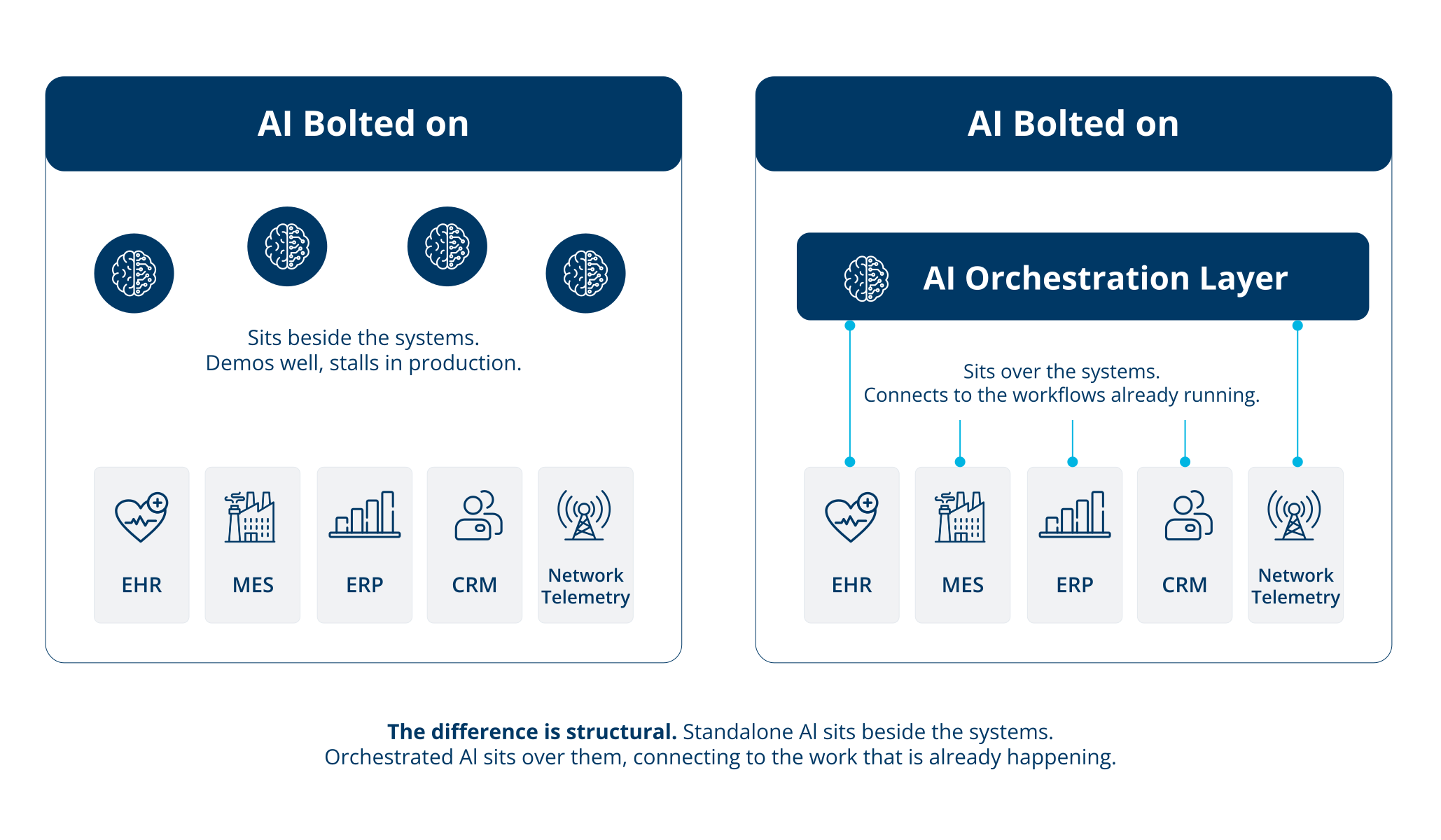
Enterprises do not run on a single system. They run on a stack of them, an EHR or a claims system, an MES or an ERP, a network management platform, accumulated over years and holding the workflows the business actually depends on. When AI is added as one more standalone tool beside that stack, it does not connect to the work. It demos well and then stalls.

AI orchestration means the opposite. Instead of bolting AI on beside the systems of record, it works as a layer over them, coordinating and AI-enabling what is already running without ripping anything out. The systems stay. The workflows stay. The AI becomes the connective layer that makes them more capable than they were.
Why vertical AI orchestration is more than the sum of its parts

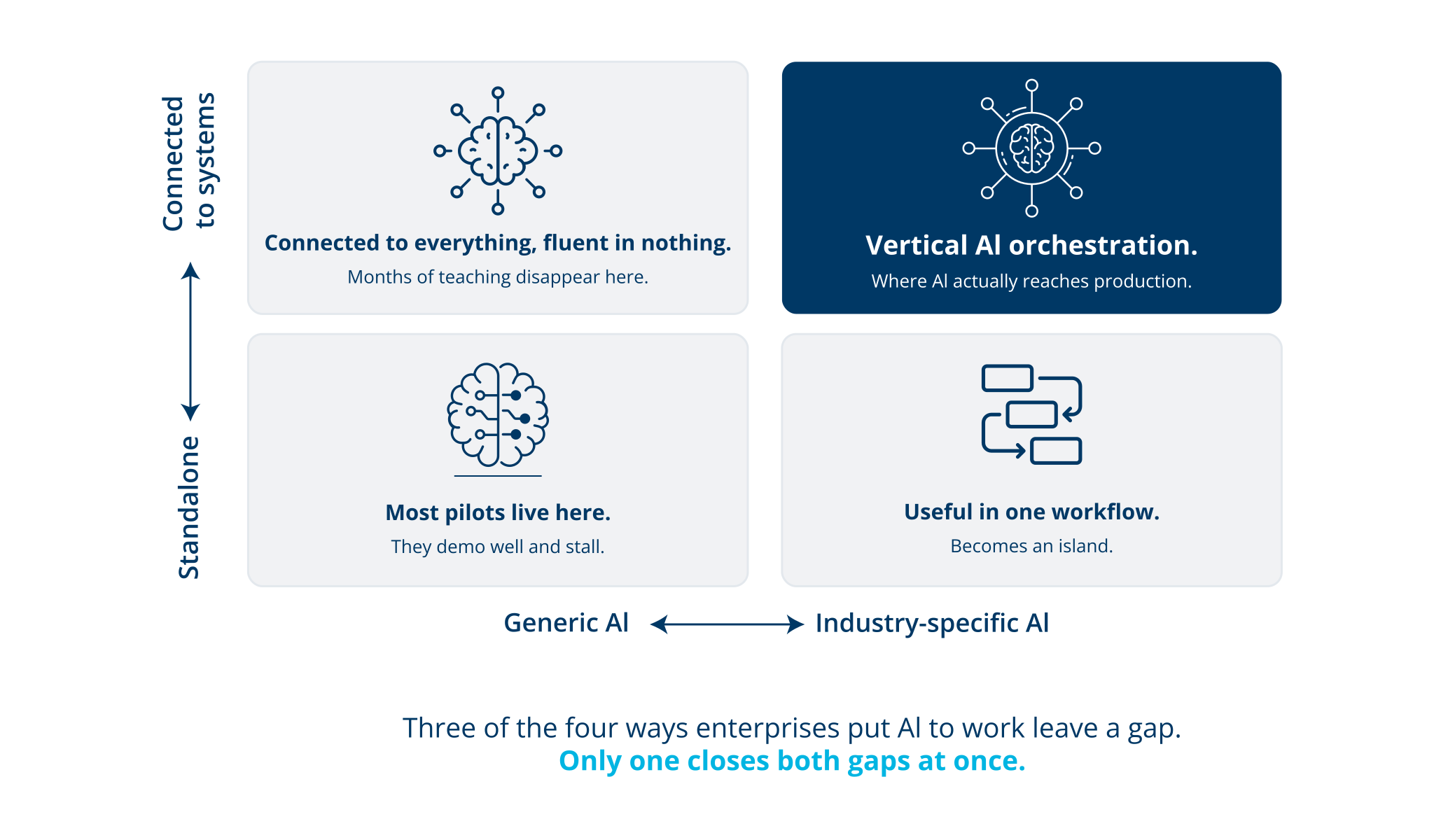
Each idea delivers value on its own. Vertical AI produces real results inside a single workflow. Orchestration brings order to a sprawl of AI tools. But each one alone leaves a gap.

Vertical AI on its own can become an island, fluent in the industry but disconnected from the other systems the business runs on. Orchestration on its own can coordinate AI components that still do not understand the work, connecting tools that do not fit the workflow.

Vertical AI orchestration closes both gaps at once. It is industry-fluent and connected across that industry’s systems, which is what it takes to move AI from a working pilot to production at scale. That combination is the reason the category exists, and it answers a problem the numbers make impossible to ignore.
Why most enterprise AI never reaches production

The instinct is to blame the models. The real blocker is fit and connection. Generic AI does not understand the work, and standalone AI does not connect to it.

The numbers make the gap impossible to ignore. HFS Research finds that roughly 80% of large enterprises plan to replace human-led services with AI-led solutions. The execution tells a very different story: in the same research, only 5% to 7% of enterprises are fully scaling AI solutions, held back by challenges with data, processes, and culture.

That gap is not unique to one analyst. McKinsey’s State of AI 2025 survey of nearly 2,000 organizations found that just 6% qualify as AI high performers, attributing more than 5% of EBIT to AI, while nearly two-thirds had not begun scaling AI across the enterprise at all. McKinsey attributes the gap to AI that never gets integrated into workflows and processes.

Vertical AI orchestration is the approach built to close both gaps, which is why it is moving from a phrase in the market to a category the enterprises are actively evaluating.

Vertical AI orchestration platform: where VeltrisOne fits

A vertical AI orchestration platform is the productized form of this idea. VeltrisOne™ is the Vertical AI Orchestration Platform that securely AI-enables industry workflows for micro-industries. It does not list AI tools for buyers to assemble, and it does not stay generic. It arrives fluent in an industry and sits as a layer over the systems an organization already runs, organized into industry clouds, with industry-specific applications, autonomous agents, and a data and integration fabric connecting it all to live systems.

The full picture, what is inside VeltrisOne and which industries it serves today, is in the VeltrisOne: the Vertical AI Orchestration Platform, explained.

Veltris is recognized for its Vertical AI leadership, named to Constellation Research’s Top 30 AI-First Service Firms and featured in HFS Research’s Challengers’ Code report.

From defining the category to closing the gap

Defining the category is the easier part. The harder question, the one every enterprise AI buyer is trying to answer, is why so much of the AI they have already piloted never reached production. That failure pattern is more specific than “AI is hard,” and it is the subject of the next piece in this series.

For now, what matters is this: orchestration is not generic coordination, vertical is not horizontal, and the difference between an AI project that ships and one that quietly does not is the layer doing the connecting.

See it on your own workflows. Request a demo at veltris.ai, tailored to a specific industry workflow.
VeltrisOne™: The Vertical AI Orchestration Platform, Explained VeltrisOne™: The Vertical AI Orchestration Platform, Explained

Most enterprise AI never reaches production. The reason was never the technology. It was industry fit, and it is the problem VeltrisOne™ is built to solve.

Enterprises are not short on AI ambition. They are short on AI that survives contact with a real workflow. HFS Research finds that only 5 to 7 percent of enterprises are fully scaling AI today. The other 90-plus percent are stuck in the same place: pilots that demo well and then stall, proofs-of-concept that never reach production, strategies that never reach ROI.

The instinct is to blame the models. The real blocker is industry fit. Generic AI does not understand how a revenue cycle survives a denial, how a production line flags a defect, or how a network isolates a fault. It has to be taught all of it, the workflows, the data, the compliance rules, before it can do anything useful. That teaching is where the months and the budgets disappear. Custom builds close the gap but cost too much and take too long. So, most enterprises sit between a generic tool that does not fit and a custom build they cannot justify.

This is the gap a new category of platform exists to close. VeltrisOne™ is a Vertical AI Orchestration Platform that securely AI-enables micro-industry workflows with rapid integration. It is an orchestration layer that sits on top of the systems an organization already runs and AI-enables them without disrupting what is already working. Instead of teaching AI about an industry from scratch, VeltrisOne brings industry-ready applications, autonomous agents, and the integration fabric to connect them, already aware of the workflows, data models, and compliance requirements of the industry it serves.

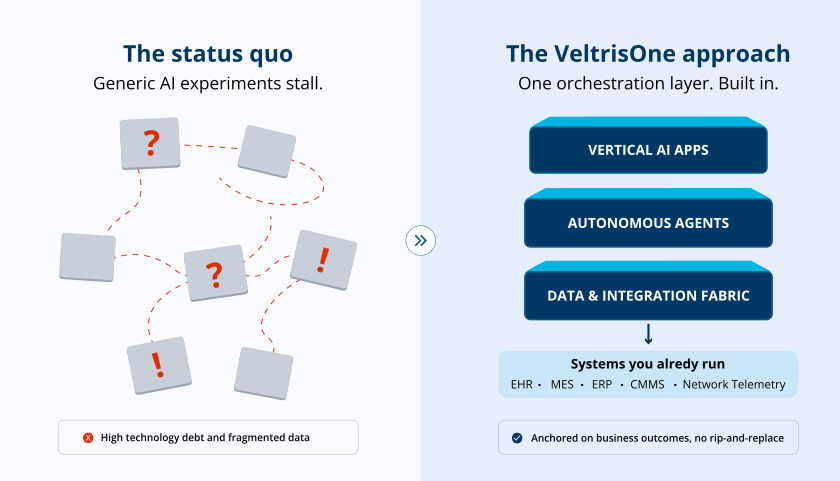
Generic AI stalls in fragmented, disconnected experiments. VeltrisOne orchestrates as one layer on top of the systems already in place.

Why vertical beats generic

The difference between VeltrisOne and a general-purpose AI platform is not a longer feature list. It is where the work starts. Three distinctions decide most evaluations.

It ships with industry fit, so the work starts at deployment, not design. Generic platforms require an enterprise to bring its own domain context, data labeling, and workflow design before any value appears. VeltrisOne arrives with industry workflows, domain-trained models, and compliance controls already in place. The first day of work is deployment, not a six-month design phase.

It connects to what you already run, rather than replacing it. VeltrisOne integrates with the systems of record an organization already depends on, from EHRs and claims systems to MES, ERP, and network telemetry, through pre-built connectors. Adopting it does not mean ripping out infrastructure. The AI layer sits on top and orchestrates across what is there.

It deploys in days, not quarters. Because the industry work is already done, deployment timelines collapse. VeltrisOne reduces time-to-value by more than half compared to custom AI builds and supports fully on-premises deployment for organizations with strict data sovereignty requirements, so data never leaves the client environment.

How it holds together

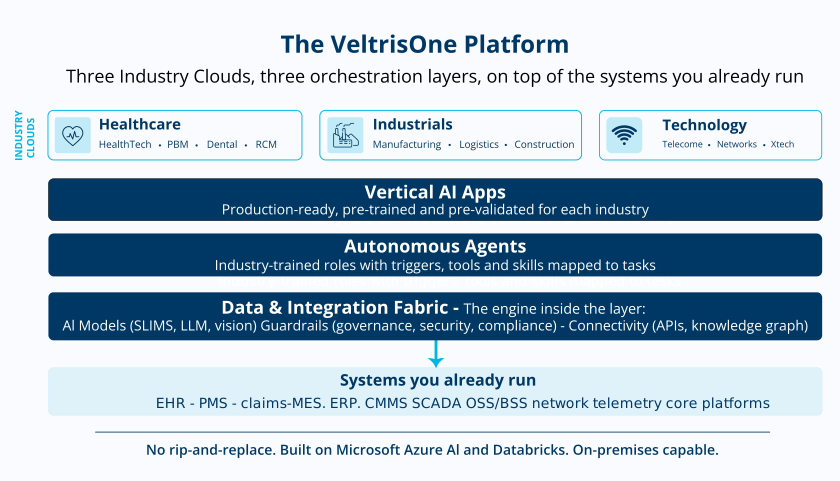
Three connected layers are what make VeltrisOne an orchestration platform rather than a collection of models. Vertical AI Apps deliver production-ready capability for specific workflows, pre-trained and pre-validated for their industry. Autonomous agents handle defined roles inside those workflows, an RCM Copilot for denial management, a Manufacturing Supervisor Agent for production monitoring, each arriving with its triggers, tools, and skills already mapped to industry tasks. Underneath sits a Data and Integration Fabric, the engine of the platform, combining domain models across SLMs, LLMs, and vision; built-in guardrails for governance, security, and compliance; and the connectivity, APIs, knowledge graph, and data integration, that links it all to live systems. The result is a direct path from an operational problem to a working solution, with governance and outcome tracking built in from the start.

VeltrisOne organizes Vertical AI Apps, Autonomous Agents, and a Data and Integration Fabric into three Industry Clouds, orchestrated on top of the systems already in place.

That capability is organized into three Industry Clouds, Healthcare, Industrials, and Technology, each purpose-built for the workflows and compliance needs of its sector. An organization adopts only one cloud, or clouds, relevant to its business.

Proof that vertical AI reaches production

The promise of any AI platform is only as good as what reaches production, and this is where vertical fit shows up as hard outcomes. These figures come from clients running VeltrisOne applications in production today.

68%
MTTR improvement, telecom (FaultAnalyze AI)
99.7%
Defect detection, manufacturing (DefectQC AI)
99.7%
Network uptime in live deployment
30–35%
Claim denial reduction, RCM (HelixFlow AI)

In telecom, FaultAnalyze AI has also reduced false positives by 85 percent; in manufacturing, DefectQC AI has cut false rejects by 92 percent and tripled inspection speed. In healthcare, HelixFlow AI targets a 30–35% reduction in claim denials and 25–30% improvement in revenue cycle efficiency. These outcomes are detailed in the VeltrisOne launch announcement.

The shift this represents

For a decade, the enterprise AI question was which model to use. The more useful question now is whether AI understands the work it is being asked to do. Horizontal tools keep losing the months between ambition and impact to the teaching of industry context. Vertical AI orchestration removes that tax by arriving fluent in the industry, then orchestrating across the systems already in place. That is the move from AI interest to AI impact, and it is why VeltrisOne is built the way it is: not broad, but vertical, and ready to run where the work actually happens.

Veltris is recognized for its Vertical AI leadership, named to Constellation Research’s Top 30 AI-First Service Firms and featured in HFS Research’s Challengers’ Code report.

See it on your own workflows. Request a demo at veltris.ai, tailored to a specific industry workflow.