
Build a Data Infrastructure for AI-Driven Financial Services



The financial sector, like other sectors, is racing ahead to provide the best customer experiences to its growing customer base. Today, the financial industry is also taking AI assistance to provide cutting-edge solutions to meet and exceed customer expectations. Data, which is considered the lifeblood of the current business world, plays a dominant role in building customer-centric solutions in the financial sector. The data is stored, analyzed, and processed to gain actionable insights. To leverage this data effectively, financial companies should use robust data infrastructure to handle vast amounts of complex data. The data collected is used to train and drive AI models that in turn help in enhancing customer experience and reduce risks.
Companies are striving to handle big data extracted from various processes every minute. This big data refers to the enormous sets of data that are complex for a traditional data processor to analyze and extract meaningful information from. To harness big data, companies must invest in the big data infrastructure setup. As such, there is a considerable increase in the global big data infrastructure market too.
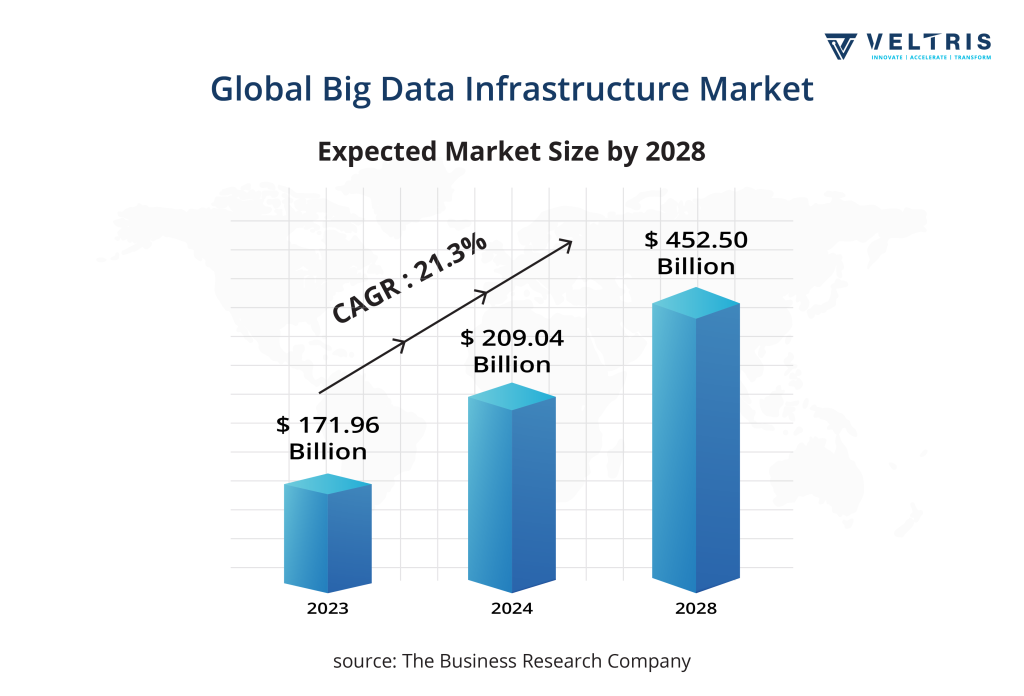
“As per the research conducted by The Business Research Company, the big data infrastructure market is supposed to witness exponential growth in the coming few years. From $171.96 billion in 2023, the CAGR is expected to rise a staggering 21.3% i.e. up to $452.50 billion by the year 2028.”

The Grand View Research also emphasized that the global market for data center support infrastructure is slated to grow from “$2.1 billion in 2021 to $7.79 billion in 2030, an almost 15.9% CAGR increase from 2022 to 2030.” As the data is available in large and increasing volumes, an efficient and robust data infrastructure is required to store and manage the big data in an effective manner.
The Importance of Data Infrastructure for AI-Driven Initiatives
Data is the life and blood of a company that uses AI to enhance its work. It is the basis or foundation for AI initiatives to be started and run. The AI models analyze the available data and provide meaningful information for further analysis. Financial companies use well-structured and scalable data infrastructure to collect, store, access, and analyze the available data. The AI algorithms and models use this data to provide actionable insights to the financial companies to take appropriate action for growth.

As per the recent research reports by intelligent data infrastructure provider NetApp, “it is believed that around 20% of AI projects might not succeed if adequate data infrastructure support is not provided to companies.” Further, the IDC White Paper titled “Scaling AI Initiatives Responsibly: The Critical Role of an Intelligent Data Infrastructure” also focused on the aspect of essential components of data infrastructure required for the success of AI projects.
AI-Driven Data Infrastructure – Essential Components
The following are a few essential components of data infrastructure that help in understanding the complete process from data collection to extraction of actionable insights.
Data Collection – The first and foremost step in finding insightful information from large sets of data is to collect data from different sources. All types of data such as structured including customer information, transactions, etc., and unstructured data like social media feeds, news items, etc., are collated for further analysis. A robust data infrastructure with suitable data pipelines, APIs, and ETL processes are used to collect data from disparate sources and ingest in one main centralized repository.
Data Storage and Management – The second step is to store and manage the collected data. Financial companies can utilize data lakes or data warehouses based on their scalability and other requirements to store structured and unstructured data. Cloud storage solutions are also known for their flexible, scalable, and accessible nature. The data collected is organized and cleansed to ensure data quality as this data is ultimately used to train AI models to make future predictions.
Data Processing and Analyzing – The next step is to process the stored data and extract insights. As the financial industry must deal with large volumes of data, Big data processing frameworks like Apache Hadoop and Apache Spark are used. While processing the data, it is run through advanced analytics tools and ML algorithms to find the patterns, trends, etc., in data.
Model Development and Deployment – Data infrastructure system also assists financial companies in developing and deploying AI models. They provide all the necessary tools such as computing resources, software, and the required framework for ML engineers and data scientists to work on. The model deployment process is also streamlined to ensure the experimentation and changes are performed by engineers without any hassles.
Data Security – The next essential step is to check data security and governance aspects. It is imperative for financial institutions to follow stringent privacy and security guidelines as they deal with sensitive data. Finacial companies should take care to use encryption, access controls, etc., while working on the data infrastructure to safeguard the customer and financial data. Financial companies also need to follow data governance rules and policies to ensure compliance while using data.
Scalable and Flexible – The last and most important step is to make data infrastructure as flexible and scalable as possible to meet the growing business needs and enormous data requirements. It should be flexible enough to deal with different data sources and analytical tools. For financial companies, Cloud-based solutions are considered as the best option as they are flexible and scalable.
Evolving Landscape of Data for AI in Financial Services
As data is at the core of AI-based services, the data landscape is evolving exponentially. Tons of authentic data or big data are collected, analyzed, and stored for further processing each day. Data has become a valuable asset, more than gold today, as AI-driven companies depend upon it to enhance productivity and efficiency. Financial services companies are no exception to it as they too depend on data for improved business and growth. The focus lies on data quality and quantity as the success of AI-driven services is based on it. Financial organizations are now seeking to establish reliable data infrastructure to manage and overcome the hurdles that may arise with the influx of great amounts of data inputs every day.
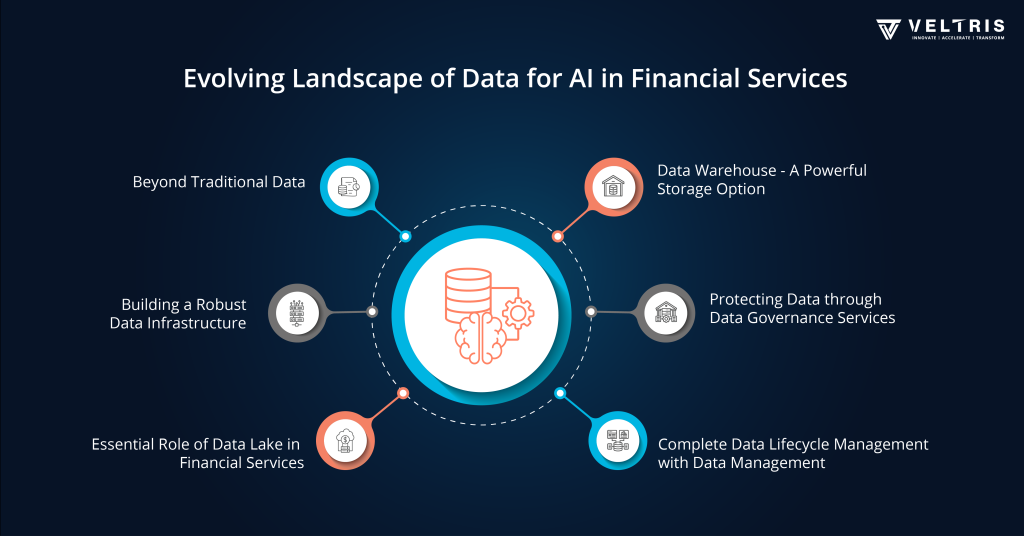
Beyond Traditional Data
Traditionally, the financial industry used to rely upon customer demographic information and transactions made to understand the customer persona and make informed decisions. However, at present, organizations need data for other essential possibilities apart from making business decisions. According to McKinsey’s 2023 report, a wide variety of data such as sentimental analysis of financial news feeds, anonymized location data, real-time data streams, etc., is collated from alternative data sources such as social media, news feeds, credit scoring, etc., to help financial companies analyze the customer spending behavior and creditworthiness. This essentially boils down to the point of managing such large sets of data effectively with advanced data infrastructure.
Building a Robust Data Infrastructure
As the complexity of AI models and the data collected increases, it becomes important for the financial companies to have a robust data infrastructure to handle the data from disparate sources, ensure data quality, and at the same time adhere to regulations. The financial sector needs to use a combination of established practices and advanced technologies to ensure that the data infrastructure for AI remains future proof. Let’s delve a little deeper and understand more about data infrastructure, the tools and practices it comprises of.
The Essential Role of Data Lake in Financial Services
A data lake is a centralized repository where large volumes of structured, semi-structured, and unstructured data are stored for further processing. Data lakes can store vast amounts of raw data in their native format whereas traditional databases store data in hierarchical table format. Cloud-based data lakes are scalable and cost-effective. They facilitate financial organizations to harness data from different sources such as social media, credit scoring, news feed, etc., and help them derive advanced analytics, predictive analytics, and perform data-related activities leading to data-driven decisions. Data lakes are flexible to allow financial organizations for analysis and future exploration.
Data Warehouse – A Powerful Storage Option
A data warehouse is a special type of database that analyzes and optimizes large volumes of structured data. Data lakes store raw data, whereas data warehouse takes care of cleaned, processed, and structured data. It acts as a central repository for data collected from different sources such as relational databases, transaction systems, etc. The structured approach in data warehouses helps in enhancing data retrieval performance. The stored financial data is useful for training AI models and provides insightful information derived from the stored historical data that eventually aids in making decisions.
Protecting Data through Data Governance Services
The data management framework that helps in making data secure, available, accurate, and usable is called data governance. It mainly ensures data integrity, quality, and security of data across financial organizations. It includes all the policies, procedures, and standards used to handle data well. Data governance facilitates meeting regulatory standards, protecting sensitive information, and enhancing the value of data assets. Data lineage tools play an essential role in 2024 by helping regulatory authorities to check the data source, changes made in ETL or ELT processes, and the final destination in the data pipeline.
The four pillars of data governance are data quality, data management, data policies and standards, and data privacy and security.
- Data Quality – Organizations can ensure data quality by focusing on the accuracy and reliability of data.
- Data Management – Data should be managed from the time of acquiring it to storing and processing it to make it useful.
- Data Policies and Standards – The data policies and standards deal with setting up guidelines for data collection, sharing, and using to ensure compliance.
- Data Privacy and Security – Data privacy and security makes sure that sensitive information is always safeguarded from unauthorized breaches.
These four pillars act as robust framework for managing and safeguarding financial organization’s data assets making it more feasible for complying with standards and regulations.
Complete Data Lifecycle Management with Data Management
Data management is the process of collecting, cleansing, organizing, protecting, storing data, archiving, and providing access control for the business’ future use. Financial organizations can make informed decisions based on such stored data. Effective data management is essential to reduce errors, ensure data usability, comply with regulatory requirements, and improve efficiency.
How Data Infrastructure Is Different for Financial Services from Other Sectors?
Financial services have different and unique requirements as far as data infrastructure is concerned because they need to stick to stringent security and compliance regulations.

Focus on Security and Compliance
The focus of financial companies is security and compliance. Data infrastructure must include robust security measures to protect sensitive financial information from cyber-attacks. There should be no scope for unauthorized access and data breaches. They must focus on providing access controls, encryption rules, and audit trails to meet the strict security requirements and save customer data.
Additionally, financial companies need to be compliant with many stringent regulations such as GDPR, CCPA, and FINRA. To ensure compliance with all the rules, they must have a data infrastructure that covers compliance with regulations that are stricter when compared to other industries.
Data Accuracy and Lineage Tracking
Data accuracy is the primary aspect that the financial sector needs to take care of as all the prime decisions of finance rely on it. Even the slightest data error or discrepancy can lead to tumultuous results. Data accuracy can be attained by performing validation checks, data cleaning, and real-time monitoring.
On the other hand, data lineage tracking will help the financial companies to trace the original source of the data, understand the transformations data has undergone, provide transparency and accountability. It helps build the trust of auditors or regulators by helping finance companies explain the evolving AI models. All this is possible by using a powerful data infrastructure.
Data Integration Complexity
Data is collected from legacy systems, third-party providers, and the latest applications in the financial sector for analysis and decision-making. Further, the data collected can be in different formats and standards; thus, turning the integration of data into a complex activity. Seamless integration of such complex data is most needed for AI applications. To ensure seamless data flow and interoperability, robust data integration frameworks and cutting-edge solutions are used to coordinate the data landscape and its activities.
Real-time data processing is another aspect that needs the financial sector’s attention. To detect fraud, manage risks, and trade algorithms, real-time data needs to be handled appropriately. Financial companies must use robust data infrastructure that allows them to scale and process large sets of data as per need.
Why Choose Veltris for Data Infrastructure?
As data is the essential element that defines the progress of AI-driven financial services, it is more crucial to set up a robust data infrastructure for seamless data storage, management, integration, processing, and governance. Veltris is a trusted technology partner that provides out-of-the-box AI solutions specifically designed for the BFSI sector.
Data Storage and Management
At Veltris, we understand the urgency of financial organizations to store and manage data efficiently. The following points provide a glimpse of our data storage and management services.
- Help the financial organizations by providing automated data sourcing and procuring options from varied data sets such as KYC, trading, forecasting, etc.
- Provide scalable and secure data lakes and data warehouses that assist in storing vast amounts of precious data
- Ensure data security and compliance aspects by adhering to various financial industry regulations such as PCA DSS, GDPR, CCPA, and others
Data Integration and Processing
Data integration and processing is an important aspect of financial services that Veltris takes care of effortlessly. Let’s take a glimpse of the solutions we offer in this regard.
- Seamlessly integrates data from diverse sources though the financial industry complexity exists
- Collates data from legacy systems, real-time transaction data feeds, and various other disparate sources
- Builds efficient data pipelines from varied systems to prepare data required for AI models
- Provides real-time stock insights to make appropriate decisions
Data Governance and Data Management
Veltris offers complete data governance framework and tools that ensure data quality and compliance with regulations.
- Integrate fraud detection into financial system
- Enhanced risk modelling
- Prevent unauthorized transactions and identity theft
- Streamlines entire data lifecycle for perfect data utilization
Cloud Based Data Infrastructure
We offer scalable and secure data infrastructure by leveraging the power of cloud services.
- Provides cloud-based data lakes and data warehouses for scalability, flexibility, and accessibility
- Fosters cost efficiency and agility
- Allows financial organizations to stay focused on core financial services using innovative AI technologies
The new AI-driven data infrastructure will deliver significant benefits.
- Personalized product recommendations, tailored offers, and proactive customer service based on data insights to ensure enhanced customer services.
- Advanced fraud detection and risk assessment models, leading to reduced losses and enhanced compliance for improved risk management.
- Streamlined and automated processes and data-driven decision-making, leading to increased efficiency and cost savings.
- Rapid development and deployment of new AI-powered products and services ensuring accelerated time-to-market.
- Improved customer satisfaction and targeted marketing campaigns led to increased revenue and profitability.
Benefits of Partnering with Veltris
By partnering with Veltris, financial institutions can overcome the data challenges and build a powerful foundation for all the future AI initiatives. Building a new data infrastructure leveraging the expertise and experience of Veltris will enable the financial companies to make way for new opportunities and innovations in AI. Let’s have a look at some of the essential benefits a financial company can gain with a partnership with Veltris.
- AI-ready data infrastructure to leverage the data and AI effectively
- Address data integration, quality, security, and scalability concerns
- Accelerate the implementation process and ensure success
- Enhanced customer experiences, improved risk management, streamlined operations, accelerated time-to-market, and increased revenue.
If you are one of the financial companies eagerly looking to leverage the power of AI, then Veltris is your one-stop solution. We can assist you build the data infrastructure as per your need. Connect with us today to learn more about our solutions and how we can help you achieve your AI-driven goals.
Schedule a free appointment with our experts to discuss your specific needs.





