
Decoding AI – Transforming Industries | Part 8: Physical AI – Bridging the Digital and Physical Worlds


Agentic AI and Physical AI: Extending Autonomy
Both Agentic AI and Physical AI revolve around the core concepts of autonomy, adaptability, and goal-directed decision-making without constant human intervention. They empower systems to tackle problems proactively across enterprise and industrial environments.
Agentic AI: Mastering the Digital Realm
As discussed previously, Agentic AI primarily operates within the digital sphere. It drives use cases such as:
- Personalized digital assistants.
- Advanced fraud detection and cybersecurity.
- Enhanced customer recommendation engines.
- Optimizing workflows for marketing, sales, and support teams.
Physical AI: Interacting with the Real World
Physical AI applies the principles of autonomy to machines and robots that directly perceive, interact with, and manipulate the physical world. We live in an era of hyper-automation and connected intelligence where the physical (hardware, robots), digital (software, data), and human worlds converge. This convergence, often associated with Industry 4.0 and beyond (Industry X.0), is giving rise to Smart Environments – Smart Manufacturing, Smart Buildings, Smart Agriculture, etc.
The journey of industrial revolutions has progressively augmented human capabilities, moving from mechanization to electrification, digitalization, and now, intelligent automation. Physical AI is a key enabler for realizing the full potential of Industry X.0, which demands fully connected intelligence and hyper-automation. It allows robots and autonomous systems to perform complex tasks in real-world settings.
Examples of Physical AI in Action
Autonomous systems powered by Physical AI include:
- Automated Guided Vehicles (AGVs) & Autonomous Mobile Robots (AMRs): Navigating warehouses and factory floors to transport materials.
- Unmanned Aerial Vehicles (UAVs) / Drones: Performing inspections, deliveries, and surveillance tasks.
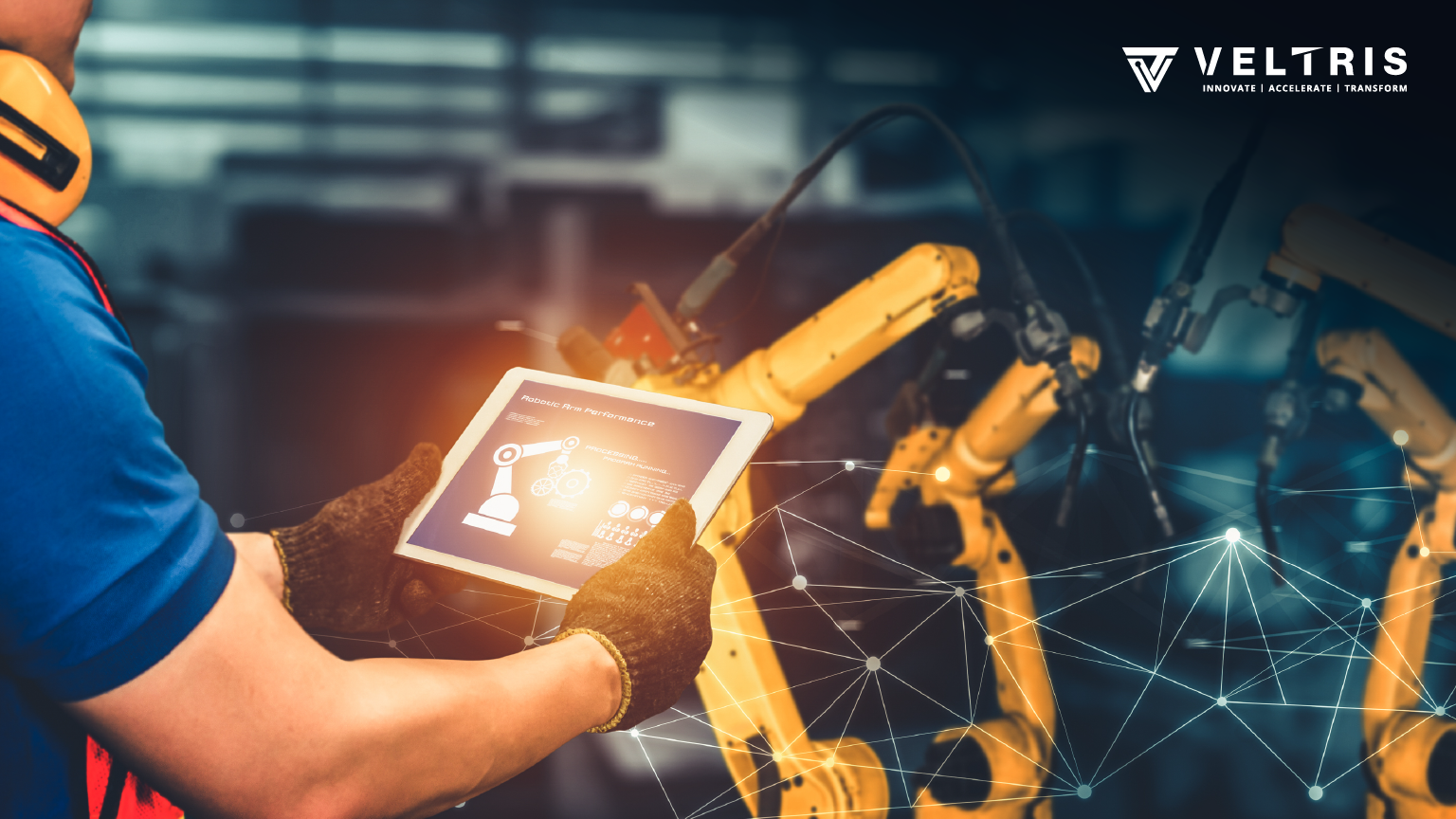
- Advanced Robotics: Robots capable of complex assembly, manipulation, and collaboration with humans in dynamic environments. These systems use sensors and AI algorithms to make real-time decisions, ensuring safe operation and efficient task completion.
The Economic Impact
Physical AI, enabling machines to interact intelligently with their surroundings, is poised to fundamentally reshape the global economy, unlocking multi-trillion dollar opportunities across countless industries.
Veltris Expertise: Enabling the Physical AI Transformation
Veltris helps businesses bridge the gap between digital intelligence and physical action. We partner with organizations looking to adopt and accelerate their Agentic and Physical AI journeys. Our expertise lies in designing and integrating the complex systems required for Physical AI, encompassing sensor fusion, real-time decision-making algorithms, robotics control, and seamless communication between digital twins and physical assets. We engineer solutions that enable autonomous operations in manufacturing, logistics, and other industrial settings, helping clients harness the transformative power of Physical AI to improve efficiency, safety, and innovation.
Conclusion
While Agentic AI transforms digital processes, Physical AI extends autonomy into the tangible world. Physical AI is a cornerstone of Industry X.0 and promises to revolutionize how industries operate by enabling machines to interact with their environment.
Call to Action
Are you ready to explore how Physical AI can automate and optimize your physical operations? Contact Veltris to discuss your specific use cases and explore synergies. Let’s partner to accelerate your journey into the future of autonomous physical systems.





