
Data Literacy: Top 4 Data Storage and Data Management Concepts



Organizations face the challenge of leveraging data, harnessing its power, and storing and managing enormous amounts of data they receive from disparate sources. If data is managed efficiently, it can provide valuable information regarding customer behavior, market trends, and operational efficiencies. Companies should follow robust data management strategies and use data warehouses, data marts, data lakes, or even advanced data lakehouses to avoid drowning in the sea of data.
This blog aims to provide crucial insights on various storage options, equipping you with the required knowledge on their strengths, applications, and the critical role they play in data strategy.
Data Warehouse: Your Business Intelligence Powerhouse

A data warehouse is a centralized repository of structured data where data from different sources such as relational databases, ERP, CRM, online transaction processing (OLTP) systems, and other enterprise or operational systems are collated. The structured approach enhances data retrieval performance, providing insightful information for decision-making.
Almost 54% of organizations adopt data warehouse as storage and management solution. The data warehousing market valued at $4.61 billion in 2023 is anticipated to reach $7.69 billion by 2028 and $43 billion by the end of 2036, expanding at the rate of 23% CAGR.

The statistics prove that data warehouses have become cornerstone of many organizations’ data infrastructure. Their role is evolving as cloud-based solutions and alternative technologies are gaining more importance. Let’s take a deeper look at data warehouse characteristics and benefits.

Key Characteristics of Data Warehouses
- Subject-oriented – Organized around specific business areas such as sales, marketing, inventory, products, etc.
- Integrated – Allows integration of data from diverse sources and transforms it into a structured format, creating a centralized and unified view of data across the organization.
- Time Variant – Stores current and historical data that makes trend analysis and comparisons over time to understand the business outcomes and growth.
- Non-volatile – Provides a stable environment, without the risk of data being changed by operational processes, for analysis and reporting.
Benefits of Data Warehouses
- Enhanced Decision-making – Ensures improved decision-making by providing a centralized and consistent view of data for data-driven decisions.
- Improved Efficiency – Streamlines data access and analysis, thereby saving time and resources leading to improved efficiency
- Historical Trend Analysis – Assists in tracking performance, identifying patterns, and forecasting future trends by performing historical trend analysis
- Data Mining & Discovery – Helps in data mining and uncovering hidden information and relationships within data
- Competitive Advantage – Provides competitive advantage by ensuring data-driven decisions that enhance performance
By carefully analyzing data warehouse benefits and characteristics, it is evident that it is indispensable for organizations that want to leverage the power of data and make data-driven decisions. Investing in a data warehouse will help evaluate the value of stored data that leads to the organization’s growth.
Data Marts: Focused Insights for Efficient Decision-Making

Data Marts are a subset of a data warehouse, designed to meet the requirements of specific departments or business units. While a data warehouse integrates and consolidates data across the organization, data mart focuses on segments such as finance, marketing, etc. Implementing data marts is part of the strategic approach to data management.
Data marts extract and transform data from larger data warehouses and other systems to create a focused dataset for a specific purpose. Data marts are strategic tools that assist in distributing data access and analysis capabilities across different teams, promoting self-service and agility.
Let’s explore the main characteristics and benefits of data marts to gain a deeper understanding of their value.

Key Characteristics of Data Marts:
- Focused – Being focused, data marts provide insights into specific business functions or departments.
- Derived – Derives or extracts information from a data warehouse or other data sources to get a specialized view of the broader data landscape.
- User-Friendly – Designed to be user-friendly, making it easy to access and analyze the specific business segment.
- Agile – Agile in nature and can be quickly developed and deployed to meet specific and changing business needs.
Benefits of Data Marts:
- Improved Decision-Making – Aids in targeted analysis and decision-making by providing selected and relevant data for meeting specific business requirements.
- Enhanced Performance – Enhances performance as data marts are smaller in size and provide faster query response
- Reduced Complexity – Assists non-technical users as data marts feature simplified interfaces and reporting tools.
- Cost-Effective – Data marts require few resources to develop and maintain, compared to data warehouses.
- Increased Agility – Turns organizations agile by ensuring faster response to changing business needs
Types of Data Marts
- Dependent Data Mart – Derives data related to a specific business area or requirement from a larger data warehouse which acts as its primary data source. Dependent data marts perform faster queries and are easy to manage as they are small and contain focused data derived from one centralized source.
- Independent Data Mart – Derives data directly from operational systems and other external sources, operating independently of the data warehouse. It is most useful when quick access to a specific subset of data is required, without relying on a full-scale data warehouse. It is highly flexible and can be customized to meet specific business requirements.
- Hybrid Data Mart – Exhibits the characteristics of both dependent and independent data marts. It can derive data from the data warehouse and integrate it with the data extracted from other external sources. It is flexible and efficient and can be tailored to meet specific business needs as well as leverage the benefits of data warehouses.
Data marts are a better option when data insights for specific business units or departments must be provided. By leveraging data marts, organizations can have focused data, improved performance and enhanced user experience to achieve greater efficiency, enhanced customer experiences, and gain a competitive edge.
Data Lakes: The Vast and Versatile Reservoirs of the Data World

A data lake is a centralized repository where large volumes of structured, semi-structured, and unstructured data are stored for further processing. They are scalable and cost-effective, facilitating organizations to harness big data. They help businesses work on advanced analytics, predictive analytics, Machine Learning (ML), leading to data-driven decisions.
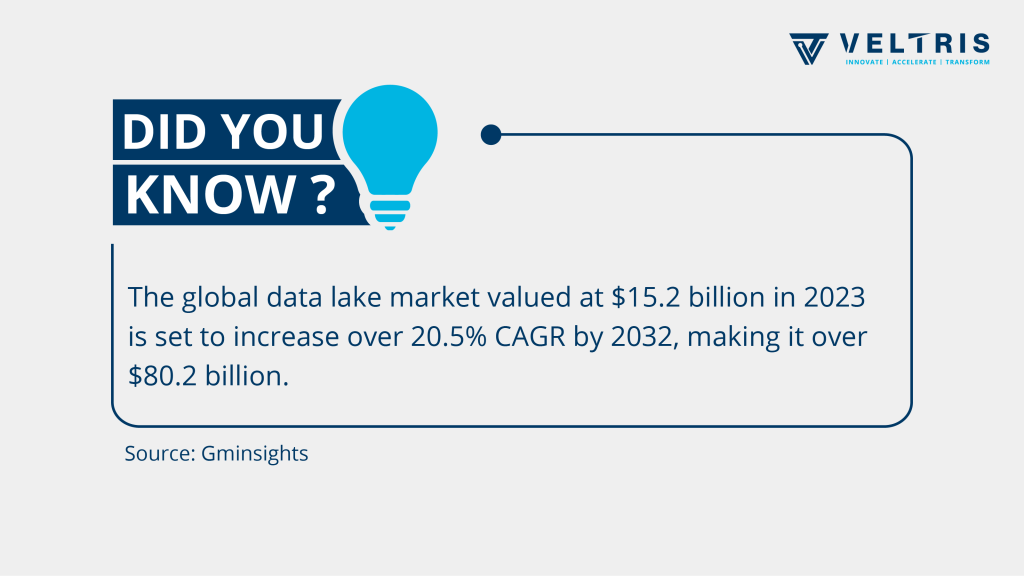
The global data lake market valued at $15.2 billion in 2023 is set to increase over 20.5% CAGR by 2032, making it over $80.2 billion. A data lake empowers organizations to explore, experiment, and discover previously unknown insights and trends. As data lakes assist in improving customer experiences and driving innovation, they play a crucial role in helping businesses achieve their full potential.
Key Characteristics of Data Lakes
- Schema-on-Read – Doesn’t store data with a predefined schema which allows for flexible analysis as per need.
- Scalability – Highly scalable, allowing organizations to store massive volumes of data from diverse sources.
- Variety of Data – Assists in storing various types of data such as structured, semi-structured, and unstructured data, including text, images, videos, logs, and sensor data
Benefits of Data Lakes
- Flexibility and Agility – Flexible and agile, enabling organizations in data exploration and support in wide range of use cases, from Business Intelligence to Machine Learning
- Scalability – Highly scalable nature allows it to easily adapt to changing data needs and handle large volumes of data
- Data Science and Machine Learning – Offers large volumes of raw data for training and developing AI and ML models
- Data Democratization – Makes data accessible to a wide range of users within the company, promoting collaboration and innovation

Thus, data lakes are a flexible solution that assists organizations in storing and managing massive amounts of raw data in structured, semi-structured, and unstructured data formats. However, care must be taken to ensure data quality and governance to maximize the benefits of data lakes.
Data Lakehouse: Bridging the Gap Between Data Lakes and Warehouses

A Data Lakehouse represents a modern data management architecture that combines the benefits of data lakes and data warehouses. The main aim is to provide a single, unified platform for both big data analytics and machine learning. It helps organizations to stay ahead by allowing batch and real-time data processing, gaining more insights from data quickly, and making data-driven decisions at all levels.
According to the 2024 Dremio Survey, 42% of organizations have moved from a cloud data warehouse to a Data Lakehouse. The growing inclination toward Data Lakehouse can be further understood by analyzing its key components and benefits.

Understanding the Key Components
- Data Lake – A vast repository of raw data in its native format
- Data Warehouse – A centralized repository for structured and processed data, providing analytics for further analysis and reports
- Metadata Layer – Most essential component that organizes and catalogs the data within the Lakehouse, making it more accessible
Benefits of a Data Lakehouse
- Flexibility and Agility – Supports structured and unstructured data, enabling it for various use cases
- Cost-Effectiveness – Provides cost-effective solutions by leveraging low-cost object storage
- Scalability – Highly scalable as it accommodates enormous amounts of data and meets changing data requirements easily
- Data Science and Machine Learning – Act as a rich source of data for training and developing AI and ML models
- Data Democratization – Ensures data democratization by allowing a wide range of users in the organization to access data at any time
- Improved Data Governance – Supports enhanced data governance and security as it provides centralized metadata management and access controls
Therefore, organizations are keen towards leveraging data lakehouse due to its scalability, flexibility, and enhanced data governance. With its innovative architecture, data lakehouse assists companies to harness their data assets and stride ahead toward growth in this age of big data and AI.
Conclusion
In today’s data-driven world, it is most essential to have a flexible and adaptable approach to data storage and management. The data warehouse handles structured data and is valuable for business intelligence, whereas a data lake provides flexibility to manage vast amounts of diverse and raw data. The innovative data lakehouse brings the best of both technologies and assists in having a unified platform, ensuring meeting diverse data types and analytical needs.
Organizations should analyze their specific business needs, appraise their data quality and data governance, and assess their data variety, veracity and velocity before they choose the data management solution. A comprehensive data strategy and the right data infrastructure are also the key components to ensure value-adding business results irrespective of whether it is data warehouse, data mart, data lake, or data lakehouse.





